
David Reay’s
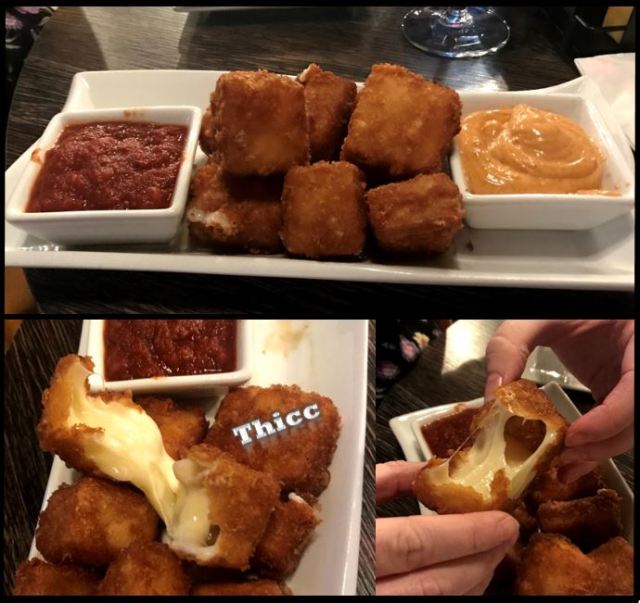
Winter in Wisconsin is an annual opportunity to test the will of the human spirit. During the week in question we had the pleasure of dealing with a snow dump totaling over a foot and wind chills in excess of -60 degrees F. Everyone has their own coping mechanisms but my favorite is to sink my chattering teeth into deep fried cheese. This particular time I took refuge at David Reay’s Modern Diner + Tavern in Onalaska, WI. The restaurant was built less than a year ago and is architecturally impressive, expertly blending modern flair with a vintage and rustic feel. They provide some fun outside the box menu options, at least compared with most restaurants in the area. This approach extends to their drink menu as well where they put a spin on the usual idea of the beer flight by offering the concept for both margaritas and mules. I ordered cheese curds and yearned for a vacation, while sipping on four flavors of margarita, as I waited.
The bad news is that $9 only bought me 9 curds. The good news is that they are enormous. If we say the average cheese curd is Chris Paul sized then these bad boys would be Giannis-Antetokounmpo-riding-piggyback-on-Boban-Marjanovic sized. Each curd took three normal bites to eat, although I chose to gobble them up with two ambitiously gluttonous chomps. But size doesn’t tell the whole story, there is more to these than their cartoonish girth.
These behemoth cheese curds also had another uncommon characteristic; their rectangular shape. They are stunning to look at with a beautiful brown batter paired with a deep red marinara and an orangey paprika-lime aioli dipping sauce on a bright white plate. Crack them open and an abundance of creamy, stretchy white cheddar cheese will spill out of the boxy shell. The batter has an excellent crunchy texture, leaving crumby memories all over your hands, perfect for the nostalgic consumer. Additionally, the cheese has a distinct but enjoyable flavor that I couldn’t quite put my greasy finger on – a hint of smokiness or aged cheddar. As a complete experience, David Reay’s was a top notch establishment to patronize, a wonderful place to retreat from the elements to devour unique and delicious cheese curds.

4.3 curds out of 5.0
Cheesy Fact of the Day:
President Andrew Jackson once commissioned a wheel of cheddar cheese that was four feet in diameter and two feet thick, weighing nearly seven tons. He invited 10,000 guests to the White House and it was eaten within two hours. However, the largest cheese ever produced was a 28.5-ton cheddar, crafted in 1989.
What’s O-Curd to Me:
When I was 4 years old I thought you could buy a house for $150. It turns out this missed the mark by a few orders of magnitude, although I probably still could have qualified for a mortgage loan in 2007 with this thinking. Children are enthusiastic, intuitive and incredibly perceptive of information that many adults ignore or deem unimportant. Unburdened by the inhibitions brought on by social pressures, they ooze creativity and are capable of producing simple, yet profound, kernels of wisdom. That said, there are countless reasons not to trust them with a variety of things, such as money management. If you had given 4-year old me $1000, without instructions, it would have been gone in 14 minutes and instead of 6 ⅔ houses I would have been the proud owner of like 75 Superman action figures a dozen Tamagotchis. Due in large part to inexperience and a narrow perspective, the decision making process of most kids is perplexing. Therefore it would be unrealistic to expect a high percentage of them to have success managing their $1000. For reasons that parallel this example, 27-year old me can’t process the insanity of pressuring under equipped high school seniors into making high stakes predictions that potentially have decades long ramifications.

Earning a college degree can unlock many doors and blaze new trails through previously impassable territory. Some people know in their bones what they are meant to do, and for them the four years reinforce their sense of purpose. They are able to graduate and begin productive, enjoyable careers without breaking stride. At another extreme are individuals who desperately desire a post-secondary education but, for any of a variety of reasons, do not have that option. My heart breaks for this group. I want to be mindful and reverential toward their plight when advocating for a set of kids to consider turning down the opportunity. Conceptually, college is an objectively wonderful prospect but, like many things, there can be a rift between theory and reality.
For the better part of a generation, high schoolers have been steered toward pursuing a college education with ideas like “a Bachelor’s degree is the new high school diploma”. The parents, teachers and counselors pushing this narrative undoubtedly have pure intentions, but unfortunately, many students have ended up in unsuitable situations and suffered as a result. Just as the 4-year old wouldn’t know how to manage $1000, 17 and 18-year olds rarely have a sense of which post high school path is best for them. They don’t yet know what they want and, to make matters worse, are working with an incomplete understanding of what is possible. The only exposure to many careers might be a blurb in a pamphlet that provides a broad description applying to the most accomplished, glamorized and established people in that field. A person would struggle to find anything substantial about the day-to-day tasks or responsibilities an entry level employee would have. Even if perfect information were available it would be ridiculous to expect a teenager, lacking tangible real-world perspective, to predict which career path would be the most fulfilling and productive for them. They are still trying to figure out who they are in the present, let alone what might captivate them over the course of 40+ years. If determining what they like and would excel at isn’t challenging enough, they also need to juggle variables like salary, job market and many more factors when picking a major. The degree of difficulty in this decision is considerable, and selecting incorrectly can have damaging long term consequences.
According to the National Center for Education Statistics (NCES) the average cost for tuition, fees, room and board to attend a 4-year school was $22,000 annually, as of 2016. Attending college is betting on a boost in future earnings, due to obtaining a degree, that outpaces an alternative income and the expense required to attain it. The optimistic case would have a student graduate in four years, find a job and begin capitalizing on their investment. I’ve created an example, that is immensely simplified, to illustrate the wager. Scenario A: attend a 4-year school at $20,000 per year and bring home a salary of $50,000 after graduating. Scenario B: start working full time out of high school, earning $30,000 per year.
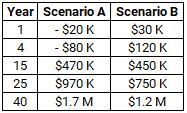
Scenario A nets more in the long run but it took almost 15 years, to break even. To further muddy the waters, 40% of those who begin pursuing a college degree either drop out or have yet to complete the degree within six years. Additionally, those who earn a Bachelor’s have no guarantee of landing a job in their preferred field, if at all. These people are now sitting on a mountain of financial obligation with no clear path to repayment. Student loans are the second largest category of debt in the United States (behind mortgages), and Forbes estimates that approximately 44 million people combine to owe a staggering total of $1.5 trillion – roughly $34,000 per person. Not only do these bills put enormous strain on the individual directly accountable but it also has a negative impact on the economy as a whole.
Deciding what to do after high school can feel like being a quarterback operating in a collapsing pocket. Sensing pressure from multiple angles leads to frantically cycling through the options – college, military, full-time job, cabin in the woods – none of them seem open, none of them feel right. But the ball has to get out, force the throw and hope for the best — or escape the pocket and buy time. Liberated from the confines of the tackle box everything slows down a bit and the situation can be managed. From this vantage point receivers who seemed covered might not be, or now taking off to run is feasible, otherwise throw it away and live to fight another day. Extra time is the friend of an 18-year old, as well as a quarterback, so it seems practical to recalibrate the time frame in which these critical decisions are expected to be finalized. I believe there could be a much more successful way of transitioning from high school to the workforce. Almost everyone could benefit from taking a year to earnestly understand themselves and discover the world. My dream would be to provide elements of structure and purpose to this gap year, making it a much more viable and appealing opportunity.
I envision a program consisting of a series of short term employments, curated to match the interest and talents of the individual, in which a livable wage would be earned. Over the course of one year, each participant would partner with three different employers for an internship, apprenticeship or job shadow. Each three month stint would be a full-time commitment where the trainee would be a contributing member of the team, immersed in the day-to-day operations of the given profession. Between each occupational period there would be a six week break. During this time each member of the program would be encouraged to continue seeking personal enrichment through travel, creating things, exploring entrepreneurship or studying an area of interest. Throughout the process they could live at home, an apartment of their own or in a dorm-like setting intended to simulate the campus experience. To join, high school seniors would apply and meet with advisers to discuss which companies would be a good fit for them. Employers would need to devote resources to facilitate the program, so prospective candidates would be required to demonstrate an appropriate level of commitment in order to gain acceptance. In exchange for their efforts, the businesses would cultivate relationships with future employees and could view it as a long term investment toward developing a pipeline of quality workers. In the present, they gain an influx of eager personnel with fresh ideas, as well as receive promotion and advertising at all school related co-curricular events while building up a substantial amount of good will throughout the community. The hope is that after a gap year the young people who participate come out with a much clearer vision for their future whether that is to join on full-time with one of these companies, pursue schooling or use what they’ve learned to continue considering any of the many other options.
I am hopeful that the system I described can someday become a possibility, but in the meantime we are lucky enough to live in an era where the self-motivated and undistracted learner has almost limitless access to free, high-level knowledge online. Those uncomfortable with self-guided learning can buy time by attending a community college to earn general credits for a fraction of the cost of a university while figuring out what comes next. Also, there is a huge surplus of great, in-demand jobs in the trades, transportation and utility industries that require less formal training prior to being hired. I urge you to check out the Skills Gap Podcast for more information about those professions and some old school wisdom on the value of hard work. Another option for the bold is to create their own future by starting a business from scratch.
I would like to reiterate that a college education has immense value and pursuing one is absolutely the right decision for many people. It’s also important to note that the very best parts of those four years are learning how to live away from home, opening the mind to new people and ideas, and absorbing as much information as possible to figure out who you are and what you believe in. Education is a beautiful thing and a worthwhile lifelong pursuit for all of us, regardless of the source. The goal for all of us is to support ourselves and our families. Ideally we can do so while contributing to society in a way that is stimulating and fulfilling. There are many paths to that endpoint, the important thing is to find a way to get there.
 Chasing the Cheese Curd