
Machine Shed Restaurant

The Machine shed, in Waukesha, is rustic in the most welcoming way. The walls are adorned with farm decor and the waitstaff wear red and white checkered button-downs that incept thoughts of roadside country diners. Paul Bunyan would fit right in and be especially pleased since even for him the cheese curds wouldn’t be bite sized. I should also note they are actually called “sheddar melts” which I fully support. They are shaped like the rear-end of a Honda Element, only fractionally smaller, and about as thick as a deck of cards. The luxuriant, grease free, batter is perfectly colored; with flaky dark brown batter barnacles protruding from the golden body that along with small embedded green flecks add depth and texture to the appearance.

The multitude of delicious white cheese is secure within its coating which is satisfyingly crunchy, especially around the edges. They taste like a giant Cheez-It gusher or some sort of dairy Oreo – tough tasty exterior with a creamy filling. The only quibble I can make is that they are borderline inconvenient to bite through.
The sheddar melts are a delightfully unique spin on the traditional cheese curd and executed to perfection in several areas of consideration. This probably isn’t the best way to introduce a first timer to the deep fried cheese curd experience because of their non-traditional nature but is an excellent product for the experienced curd consumer looking for something new. The hearty serving comes with a side of ranch on a faux wood platter and garnished with greens for the economical price of $8.49.

4.7 curds out of 5.0
Cheesy Fact of the Day:
Philadelphia cream cheese is named after a tiny upstate New York town near the Canadian border, not the home of Jim’s beloved Phillies.
What’s O’Curd to Me:
A quick Google search of “The Office” summons enough mind-boggling statistics to fill multiple reams of Dunder-Mifflin’s finest 28-lb premium stock paper. Nielsen reported that last year the show played for 45.8 billion minutes on Netflix, making it by far the streaming platform’s number one show. “Friends” was the second place finisher, but to put into perspective the gap between them, consider Mario Kart for N64 (perhaps “The Office” of video games for those born during the George H.W. Bush administration). If a race between the two shows was being held at Royal Raceway then “The Office” would be crossing the finish line as “Friends” was about to go airborne off the big jump…on the third lap. That is why Netflix has reportedly paid “far more” than half a billion dollars for the right to stream it, and the reason NBC will pay $500 million over the next five years to stream it exclusively on it’s own platform starting in 2021. Since it’s way over my head as to why NBC has to pay that enormous sum for a show it already owns, I’m going to focus on a different question: how much would it have cost to film and produce “The Office” if it hadn’t been a mockumentary but an actual non-fictional enterprise?
The Scranton, PA branch of a mid-range paper supply company, Dunder-Mifflin, is in many ways the type of ordinary and unremarkable workplace that millions of Americans begrudgingly schlep off to for 40 hours per week. That was until, in 2005, an employee named Tom Peets committed suicide (the reason Ryan is hired from the temp agency was to be his replacement). An executive from PBS decided documenting how co-workers cope with tragedy and loss while attempting to carry on with their duties was a project worthy of the network’s resources. I will make many assumptions and not-so-educated guesses throughout this exercise, the first of which is that PBS had likely intended to film only for a few weeks, or maybe a couple of months. But at some point they fell in love with the subjects and determined they had accidentally drilled into a Mother Lode that could be mined for content that required their continued attention. On “The Office” the program turned out to be nine episodes titled “The Office: An American Workplace”, but for our purposes I will consider the whole of “The Office” as the documentary. Filming takes place over a ten year span – nine seasons plus the reunion a year later – totalling 201 episodes with a runtime of 4199 minutes.
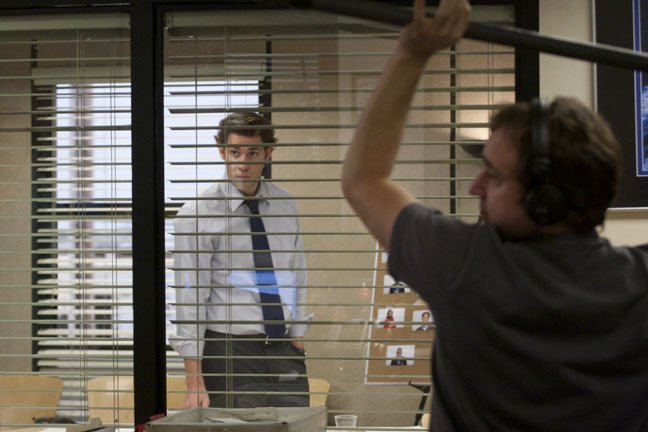
The crew is a silent, unseen character (at least until Season 9 when we meet Brian) that adds to the humor with quick pans over to an unsuspecting Creed doing something Creed-like and with shots of Meredith that zoom in on her drink. Depending on the project it can cost anywhere from $1500 – $10,000 per day to hire a film crew, but we are going to assume PBS has the staff to create this documentary in house. These employees will be paid hourly and earn overtime when exceeding 40 hours in a week. This venture is fairly simple; capture the day to day operations of the employees and what occurs in the office. Most of the time the work can be done with one cameraperson and a boom mic operator. It gets trickier when Michael decides to do things like delivering gift baskets to lost clients throughout Lackawanna County with Dwight, and even more difficult when he is sent to Winnipeg, with Andy and Oscar, to woo a prospective Canadian associate. In these cases an additional cameraperson, at a minimum, will be required. Quick aside: this would be a complete scheduling nightmare, and could you imagine explaining to your family that you will miss yet another dinner because you need to film Dwight sitting in his car trying to catch Oscar playing hookie?
Multiple Crews
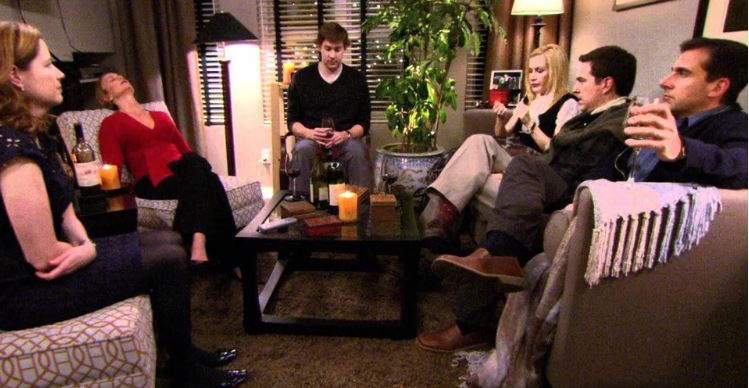
Our default assumption is that one crew will be able to capture all of the action in a given week, but there are times when that simply won’t be possible. For example, Jim spent a sizable chunk of Season 3 working out of the Stamford branch. Much of the footage seems to occur in parallel with the events in Scranton, and the Jim and Pam phone call could not have been filmed with a single crew. A few other notable situations would include almost anything involving Dunder-Mifflin Corporate in New York City, sales calls (some could be captured with dash cams, like Phyllis and Karen’s makeover, but not all) and the majority of the Michael Scott Paper Company run. With good instincts, a single crew could theoretically cover the bulk of the work but I would estimate an additional cameraperson, or more, would have been necessary roughly ⅓ of the time.
Late Nights and Weekends
The Party Planning Committee overflows with toxicity and blackmail but perhaps that is partially due to stress from the amount of weight they are required to pull as the Scranton branch seems to have some sort of party almost every week. Between the holiday parties, events such as the booze cruise or casino night and visits to Poor Richard’s there is no shortage of after hours shenanigans. Our tireless crew even captures many important life events about their subjects. We witness three weddings and a christening that occur during those sacred days at the end of each week. All of this adds up to a lot of overtime. Over the course of the series I approximated the average amount to be about 5 hours per week.
Travel Expenses
The Dunder-Mifflin gang did a fair amount of travelling over the course of nine seasons which means so did our dedicated PBS staff. The biggest one would seem to be the aforementioned Stamford stint with Jim, at 150 miles from Scranton it is most likely that the crew spent their nights in a hotel rather than making the journey home. Similarly, the same might be true in stretches when visiting Pam at Pratt (121 miles to NYC) or checking in on Jim and Darryl at Athlead (125 miles to Philly). A couple more notable adventures include Michael’s lecture circuit and the Halpert-Beesly nuptials in Niagara. Sometimes it was necessary to hop on a plane; Winnipeg as well as the extended trip to Tallahassee, including keeping up with Erin who decided to remain in Florida. I checked with Toby in regards to travel expenses and he has agreed to allot $100 for a hotel stay, $50 a day in meal vouchers and $500 per flight.
Editing
With the film crew there are a lot of different considerations to make, but the editing is a little more straight forward. We can work backwards from the total finished runtime to determine a reasonable price estimate for editing. Hollywood movies spend upwards of 20 hours tinkering in post-production for each minute we see on screen, which is nearly identical to the amount of time I spent procrastinating on each paragraph in this piece. News broadcasts are on the opposite end of the spectrum, they efficiently cut together their clips in as little as an hour per televised minute. The trash Kelly watches falls somewhere in the middle. Documentaries, like this, take less time than movies since there aren’t dozens of takes to sort through for each scene and it doesn’t require special visual or audio effects to be added in. “The Office” is about as bare bones as it gets, the biggest challenge is simply the enormous amount of raw footage to sort through. Editing this project is taking a block of marble and chipping away until a story worth telling remains. My best guess is that to free that sculpture the editor will have to carve 6 hours for each 60 seconds of streamable content.
The Total
My research indicated that ~$1000 per minute of completed video is a rule of thumb for the cost of documentaries (which would put “The Office” at a cool $4.2 million) but for many of the reasons already discussed we should expect to come in quite a bit cheaper. I put Angela, Oscar and Kevin to work compiling the numbers and the results are in.
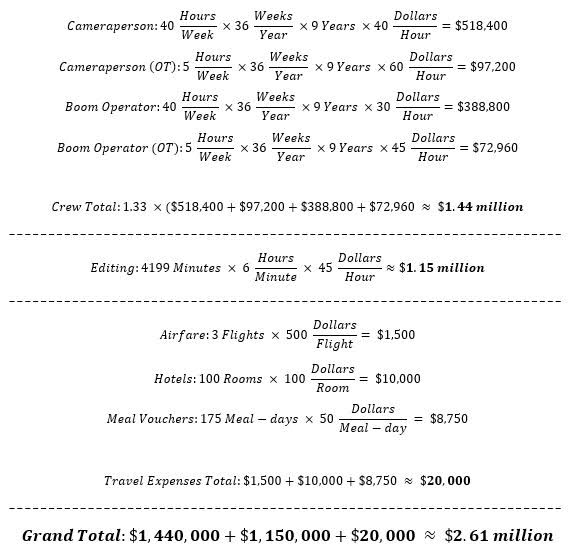
That is a LOT of Stanley nickels.
 Chasing the Cheese Curd